
Everyday French : À l’hôtel – Écouter l’épisode
Learning everyday French is essential if you want to sound natural in real conversations. While textbooks teach you grammar and formal expressions, they often miss the casual phrases French people actually use in daily situations.
If you’ve ever wondered how to order coffee like a local or what to say when shopping at a French supermarket, here are some expressions you’ll find helpful.
Why learn everyday French phrases?
I’ve realised how important learning everyday phrases in your target language is actually CRUCIAL for basic tasks. You can learn all the grammar you want, but what if you do not know when to apply it for, let’s say, ordering coffee?
I’ve found myself in this situation during my last holiday in Spain, and had some trouble expressing myself while I was out doing… basic tasks.
Real everyday French is more casual, faster, and full of expressions you need to learn separately.
Français de tous les jours | Everyday French: À l’hôtel en français
- Bonjour, j’ai une réservation au nom de…
Hello, I have a reservation under…
- Vous avez encore des chambres de libres ?
Do you still have any rooms available?
- C’est possible d’avoir une chambre au calme ?
Is it possible to have a quiet room?
- Vous auriez une chambre avec un grand lit ?
Would you have a room with a double bed?
- Le petit-déjeuner est compris ?
Is breakfast included?
Vocabulaire :
Un grand lit = literally a “big bed” but would mean a double bed.
au calme = (in) quiet

Vous voulez vous entraîner à pratiquer le français de tous les jours ? Essayez Langua !
20% OFF your annual UNLIMITED plan
with code EDEN20
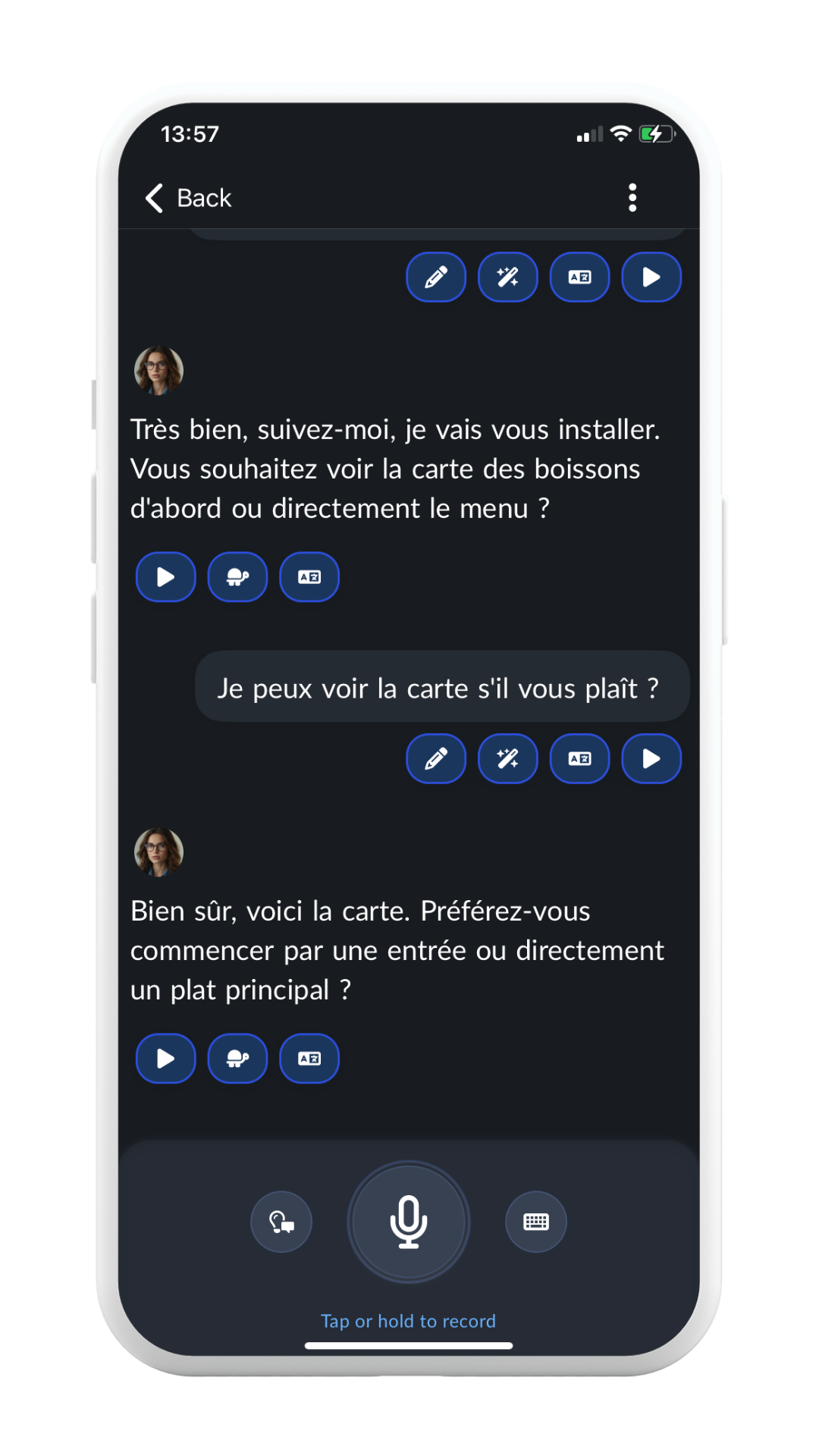
- Practice without pressure
- Get instant feedback and corrections
- Realistic AI voices
Le petit-déjeuner, c’est jusqu’à quelle heure ?
Until what time is breakfast served?
Vous pourriez me redonner le code du Wi-Fi ?
Could you give me the Wi-Fi code again?
Ma carte ne marche pas.
My (key) card isn’t working.
Je n’arrive pas à ouvrir la porte.
I can’t open the door.
Le chauffage ne marche pas / Le chauffage marche pas.
The heating isn’t working.
Vocabulaire :
Ne pas arriver à = To not be able to…
Note: In everyday spoken French, we tend to remove the ‘ne’ in negation.
Le chauffage ne marche pas = Le chauffage marche pas.
- Est-ce que vous avez une navette pour l’aéroport ?
Do you have a shuttle to the airport?
- Il n’y a pas d’eau chaude.
There’s no hot water.
- Je peux avoir une serviette en plus, s’il vous plaît ?
Can I have an extra towel, please ?
- Est-ce que vous avez une consigne ?
Do you have a baggage room?
- C’est à quel étage ?
What floor is it on?
- Il y a un ascenseur ?
Is there an elevator?
Vocabulaire :
Une navette = a shuttle
Une consigne = a baggage room
Un étage = a floor (in a building)
Il faut libérer la chambre à quelle heure ?
What time do we need to check out?
Je vous laisse la clé sur le comptoir.
I’m leaving the key for you on the counter.
Est-ce que vous pourriez appeler un taxi pour moi ?
Could you call a taxi for me?
Est-ce qu’il y a un parking pas trop loin ?
Is there a parking lot not too far away?
Vocabulaire :
Libérer la chambre = literally to ‘release’ the room, to ‘free’ the room. Means here, to check out.

You might also like
Et vous ? Connaissez-vous d’autres expressions utiles en français de tous les jours ?
Do you know any expressions that could be useful in everyday French?